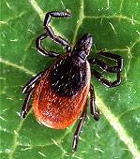

Ticks do not fall from trees, as is often maintained!
They are usually brushed off grasses, bushes and at the edges of woods up to knee height. A tick can remain on clothing for several hours before reaching its preferred sites on the body. Light, fastened clothing makes it easier to see picked up ticks. Ticks are also active in gardens and parks, i.e. in residential areas.
You’ve been bitten by a tick, even though you have not spent time in the countryside!
This is basically possible if you come into contact with pets (ticks remain on the animal’s coat for some time).
Why was the bite not noticed?
When they bite ticks secrete inflammation-inhibiting substances which have an analgesic effect. This is why the bite is not noticed.
Does the danger of infection with TBE exist only in early summer?
TBE (early summer meningoencephalitis) does not occur only in early summer; possibility of transmission exists from spring until late autumn.
TBE viruses are located in the salivary glands, which is why these pathogens can be transmitted at the very beginning of the act of sucking (release of salivary secretion).
How quickly does infection take place?
Borreliae are usually found in the middle intestines, so according to the most recent findings firmly attached ticks should be removed as soon as possible, as the risk of infection is only slight in the first 12 hours after the tick bite. When the tick sucks it absorbs fairly large quantities of blood fluid. The tick maximises absorption of substances that can be used for nutrition by putting back even larger quantities of fluid (mainly superfluous water + ions) into the host. In this way the tick retains its internal osmotic balance. It is obvious that this makes it possible for the bacteria present in the intestines to find their way into the host, and indeed all the more the longer the act of sucking lasts.
A study on gerbils supports this theory, as irrespective of the removal technique a rising rate of infection was observed with increasing duration of the act of sucking.
What is Lyme disease?
Borreliosis is also called Lyme disease, because this infectious disease was first observed in the USA in the town of Lyme.
Can you become ill simultaneously with borreliosis and TBE?
Basically, yes, if you are in areas where TBE is widespread.
How often does the tick have to absorb blood?
The tick (hard-backed tick) has to absorb at least three blood meals after the egg stage, in each case one as a larva, a nymph and an adult tick. After each blood meal the tick leaves the host, digests the blood meal and develops and moults into the next stage of development (larva to nymph, nymph to adult tick).
Fully attached adult females leave the host, lay up to 3000 eggs and then die.
The life cycle of hard-backed ticks very often goes through long periods without taking in food; the European "common wood tick" (Ixodes ricinus), for instance, whose overall development lasts 2-6 years, spends up to 99 % of its life without food. All attached and unattached stages of development are basically capable of hibernating.